A China resident bought a bundle of old China town reports, which have fallen into your writer’s hands for her – and your – information and entertainment. Thank you, John Glowa!
The earliest of the 21 reports (plus two duplicates) is for the municipal year 1860-1861, which ran from mid-March 1860, to mid-March 1861. It is incomplete; there are seven pages of information from the selectmen, but the supervisor of schools’ report promised on the front page is missing.
The latest report in the collection is for the year ending Feb. 20, 1906. Because the fiscal year had just changed, this report covers the 11-month period from March 10, 1905.
The reports are printed on old-fashioned paper that feels soft to contemporary fingers, and they’re smaller than today’s. The samples from the 1860s are 5.5-by-9.5 inches, and 16 pages. The 1872-1873 report (for the year that ended March 18, 1873) is another 16-pager, but the pages are only 5.25-by-7 inches.
From the 1880s into the 1900s, pages are 8.75-by-5.5 or 8.75-by-5.75 inches. In the first decade of the 20th century, the reports ran 36 or 38 pages (44 pages in 1905).
Earlier reports in this collection have no covers, later ones soft covers. The only colors are on some of the later (1884 and after) covers, and they are muted – beige, medium green, reddish-orange. The contents are entirely words and figures, without illustrations.
In contrast, the China town report for the fiscal year ended June 30, 2024, has stiff covers with color photos front and back, outside and inside. Its 100 8.5-by-11 pages have numerous black and white photos, charts and graphs. Most of the pages are white; the last four sheets of paper, with the warrant for the June, 2025, annual town meeting, are yellow.
The report title changed over the years. In 1861 and 1863, it was the report of the selectmen and supervisor of schools, in 1864, 1865 and 1866, the selectmen and superintending school committee.
In 1873, 1877 and 1878, the annual report was from selectmen, assessors, overseers of the poor (the same three men held all three titles) and supervisor of schools. In 1879 and 1880, only the selectmen and supervisor of schools were listed.
Selectmen changed to municipal officials from 1882 through at least 1890. In 1890, the board of health was also on the cover, and the supervisor of schools.
In 1900, 1901 and 1902, the annual report was “of the Town of China.” In 1903 through 1906, it was “of the Municipal Officers of the Town of China.”
The municipal officers worked with multiple printers. The Maine Farmer Office in Augusta did the 1860s issues your writer has. The small-size 1873 report was done by Homan and Badger, Augusta; the 1877 report by Maxham and Wing, Mail Office, Waterville, for $21; the 1878 report by the Kennebec Journal office in Augusta.
Despite the report for 1878 plainly saying the printer was the Kennebec Journal office, the report for 1879 – printed by E. F. Pillsbury & Co., Augusta – reported $21 paid in 1878 to Sprague, Owen and Nash for “printing reports.” The 1879 expenditure list, in the 1880 report, said 1879 “printing reports” cost $18; it did not name the payee.
The 1881-82 report was printed at the Sentinel office in Waterville; 1883-84 in Waterville by The ‘Sentinel’ Steam Print; 1886-87, “Printed at the Sentinel Office.”
The collection has a gap until the report for the year ending March 7, 1890 (for the 1889-1890 year); it was printed at the Journal Printing Office, in Fairfield. (The newspaper The Fairfield Journal was published from July 2, 1879, to June, 1925, according to the Fairfield bicentennial history.) The cost for the prior year was $15.
Hallowell printer Charles A. Prescott did (at least) two reports in a row, 1900-1901 and 1901-1902. The bill for the latter was $34.40, paid to C. A. Prescott. The 1902-03 report was printed by E. C. Bowler, in Bethel; it included in miscellaneous expenditures $28 to E. C. Bowler for printing town reports.
That payment suggests E. C. Bowler was paid for the 1902-03 report before it was published. But the 1903-1904 report, published in March 1904, says it was printed by News Publishing Co., in Bethel; and includes a $31 payment to E. C. Bowler for “printing town reports and Com. blanks [whatever they were].”
News Publishing also did the 1904-05 report, which included an expenditure of $29.40 for printing town reports (no payee named). In the 1905-06 report, printed by Herald Job Print, in Damariscotta, the cost for printing the previous year’s town report was $33.60.
No report said how many copies the town ordered.
The town report for the year that ended June 30, 2024, does not list town report printing specifically. Town Clerk Angela Nelson found in the records that on May 23, 2024, the town paid Bromar, Inc. (Bromar Printing Solutions, in Skowhegan) $2,579.00 to print 600 town reports.
* * * * * *
China had three selectmen for each of the years included in this collection. The selectmen’s reports always started with a financial report, with the format varying slightly over the years.
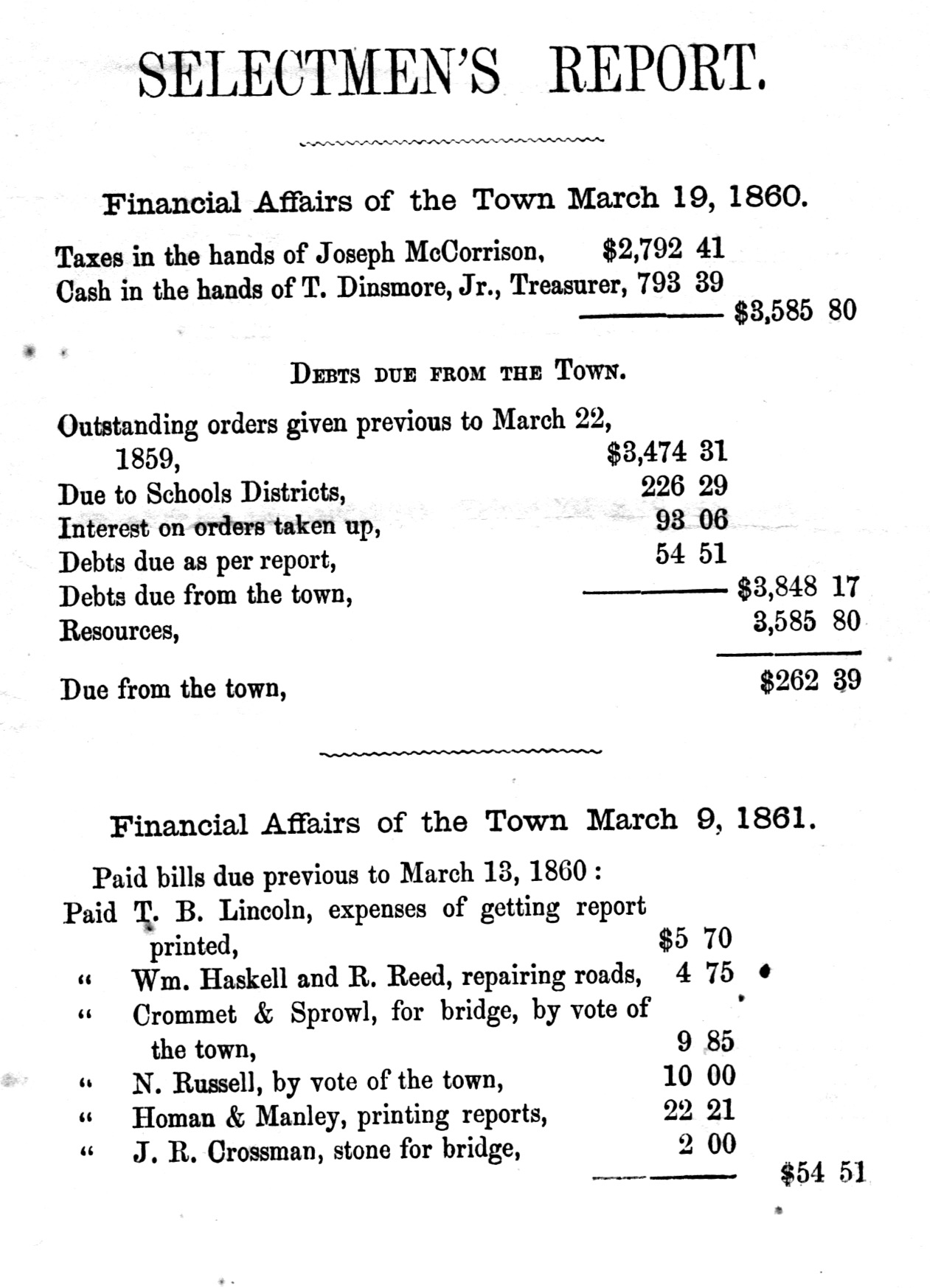
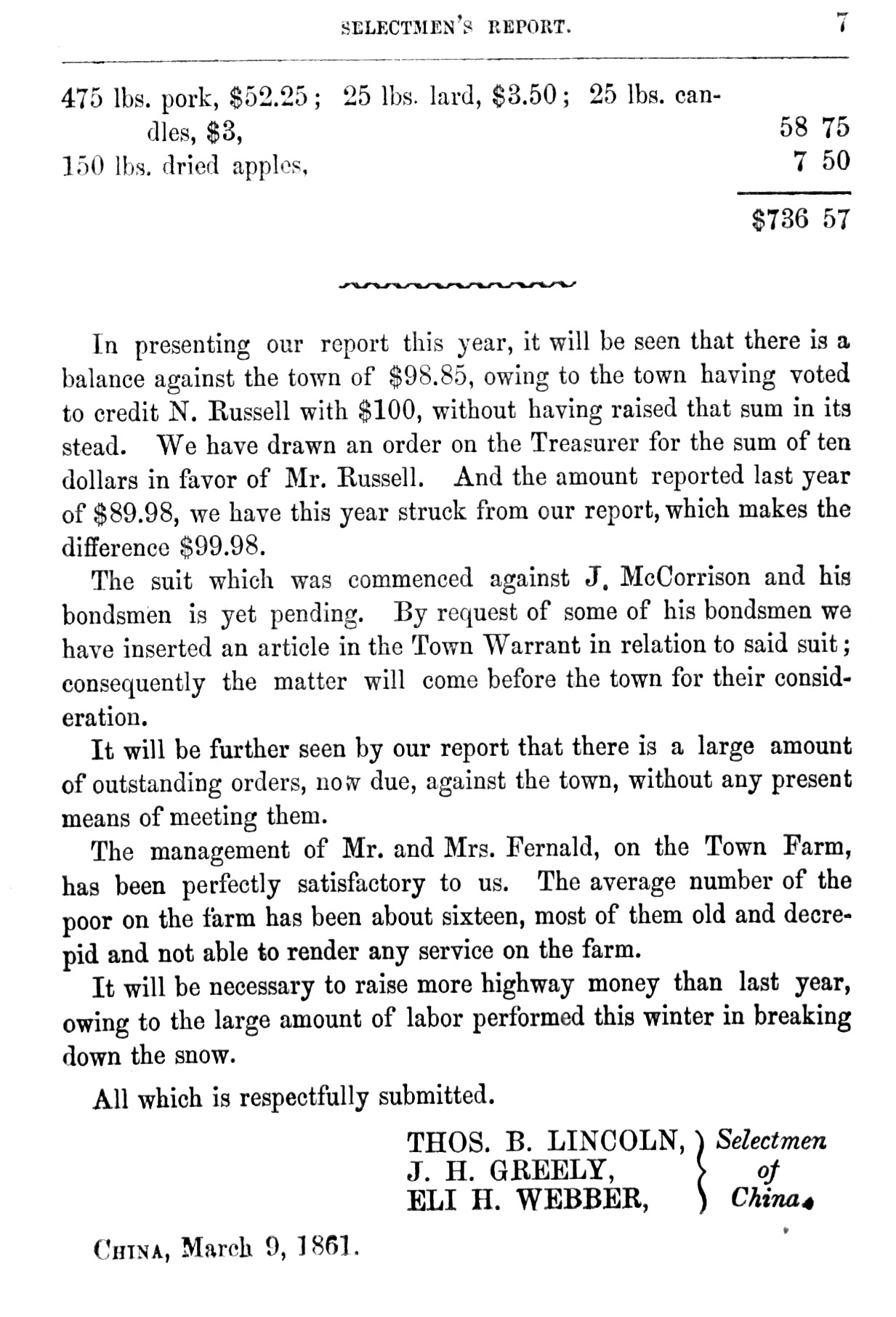
Here are a few financial highlights from the report that covered the period from March 19, 1860, to March 19, 1861. The report was “respectfully submitted” and signed by Thomas B. Lincoln, J. (Josiah) H. Greely and Eli H. Webber.
As of March 19, 1860, the treasurer and tax collector, between them, had $3,585.80. However, China owed $3,848.17, mostly due from before March 22, 1859; leaving a negative balance as of March 19, 1860, that the report calculated as $262.39 (your writer’s math disagrees; she cannot explain the discrepancy).
By March 9, 1861, the town had paid $54.51 worth of bills due before March 13, 1860. The largest payment was $22.21 to Homan & Manley for printing reports; the smallest was $2, to J. R. Crossman for “stone for bridge.” Another payment listed was $9.85 to Crommet & Sprowl, “for bridge, by vote of the town.”
The 1860-1861 miscellaneous bills paid totaled $4,663.29, including $618.66 for “Orders given previous to March 22, 1859” and interest thereon. To this figure were added $729.36 for caring for paupers, on and off the town poor farm, and $214.64 for six town officers.
Selectmen earned three different amounts: $34.50 for Greely, $43.50 for Lincoln and $44.25 for Webber. Each got an allowance for “Horse, carriage and expenses” (Greely $9.75, Lincoln $14.50 and Webber $10.14). School supervisor G. (George) E. Brickett (see box) was paid $40, treasurer Thomas Dinsmore Jr., $10 and town clerk A. (Ambrose) Abbott $8.
The result the selectmen summarized was that as of March 9, 1861, the town had $2,975.11 in “resources brought down”; and it owed $3,073.96 (of which $2,948.69 was, again, from before March 22, 1859), leaving a “Balance against the town” of $98.85.
The 1861-1862 report is not included in the collection your writer has. By March 11, 1863, China’s financial condition was worse. Selectmen Lincoln, Dinsmore (former treasurer) and Daniel Webber reported resources totaling $6,760.18 and expenditures of $14,556.64, more than half for Civil War payments to volunteers and their families. The result was a negative balance of $7,796.46.
In addition, the next page showed China was in debt to the tune of $10,366.21. In a brief summary report, the selectmen explained that loan repayments were due in “one, two, three and five years, interest annually.” They expected about $1,100 due from the state “soon.”
China (like other Maine towns) continued to pay off war-related debt for years. In March 1876, in what the China bicentennial history calls “a small revolution in China’s town government,” voters elected three new selectmen, Dana C. Hanson, Samuel C. Starrett and Freeman H. Crowell, who intended a financial turnaround.
The history says voters also appropriated funds to pay interest, but not to pay off debts, and authorized selectmen to continue borrowing.
When the threesome took office, China’s debt was $18,241.30. Income from property taxes in 1876 was $10,341.57.
At the March 1877 town meeting, the selectmen were re-elected, and voters authorized raising enough money to pay off the debt. At a May 1877, special meeting, those attending were asked to rescind that vote; they refused.
A year later, as of March 20, 1878, the town report showed the “Balance in favor of the town” was $1,173.16; and local taxes collected in 1877 had amounted to $29,791.98.
(Town officials did not save money by rejecting reimbursement. The 1877 payments for Hanson, Starrett and Crowell, and five other town officers, totaled $541.82, including horses, carriages and out of town cash expenses for the selectmen and the treasurer. The auditor and the town meeting moderator earned $2 apiece.)
In their long summary report, the selectmen praised voters at the 1877 annual meeting for their “bold step” to pay off the town debt, calling it a “hard lift” but a “wise policy.” Neighboring towns considered the action “a wild experiment, which they dare not try.”
They also praised tax collector E. (probably Elijah) D. Jepson and recommended voters re-elect him. The last sentence of the selectmen’s report reads: “Having aimed to do our whole duty, we now retire, and hope we are wiser if not better.”
E. D. Jepson is named as tax collector in each of the (incomplete) collection of town reports available to your writer from 1877 through 1886-1887. The selectmen’s report written March 8, 1887, mentioned his long illness over the winter; with help from friends, enough taxes were collected to pay state and county taxes and “every order drawn the past year.”
Although China’s 1886-1887 “running expenses” were covered, selectmen C. (Charles) E. Dutton, Theron E. Doe and H. (Henry) B. Reed wrote, there was not enough money to pay “interest bearing orders which have been so many years standing against the town,” and had cost $304 in interest in 1886. What to do about them? They answered, “resolve to pay your taxes within the year, and do it.”
Between the end of the Civil War and the 1905-1906 fiscal year, parts of China’s finances changed surprisingly little. In the 1865-1866 report, the town’s total resources were $24,770.66; in 1905-1906, they were $17,736.43.
Schools cost $2,445.12 in 1865. In 1905, five school accounts totaled $3,311.55, including $500 for a high school. Half the $500 went to Erskine Academy (founded in 1883), the other half to J. (Joseph) W. Leighton, teacher in the China Village high school (which ran from 1897 through 1908).
Highway costs increased substantially, however. They were only $18.70 in 1865, including reimbursements for damages to three wagons and one horse. By 1905, the highways and bridges account was $4,778.84, largest item in a list of miscellaneous expenditures that totaled $15,440.14.
For the fiscal year that ended June 30, 2024, the town report summary of governmental activities shows education expenditures of $5,220,626, and public works expenditures of $1,562,017, out of “total expenses” of $9,928,474.
Next week: more highlights from China’s town reports from 1861 to 1906
Dr. George E. Brickett
In the Civil War, Dr. George E. Brickett served as a surgeon in Maine’s 3rd infantry regiment, according to the China bicentennial history. He enlisted in the spring of 1861 and “resigned or was discharged in late August.” At a Sept.9, 1861, town meeting, voters chose G. B. [almost certainly Gustavus Benson] Chadwick his successor because Brickett had been appointed an assistant surgeon in the army.
In the summer of 1862 Brickett enlisted in the newly-raised 21st infantry. He survived the war; a footnote in the history says an 1884 Maine atlas listed him as practicing medicine in Augusta.
The China town report for 1862-1863 lists under town officer expenses $12 paid to Brickett as school supervisor for “part of 1861” and $52 paid to G. B. Chadwick for “same office” in 1862.
Main sources
China town reports
Grow, Mary M., China Maine Bicentennial History including 1984 revisions (1984)
Websites, miscellaneous.
Responsible journalism is hard work!
It is also expensive!
If you enjoy reading The Town Line and the good news we bring you each week, would you consider a donation to help us continue the work we’re doing?
The Town Line is a 501(c)(3) nonprofit private foundation, and all donations are tax deductible under the Internal Revenue Service code.
To help, please visit our online donation page or mail a check payable to The Town Line, PO Box 89, South China, ME 04358. Your contribution is appreciated!
https://townline.org/wp-content/uploads/2016/06/TownLineBanner.jpg00Mary Growhttps://townline.org/wp-content/uploads/2016/06/TownLineBanner.jpgMary Grow2025-12-10 14:23:282025-12-10 14:23:28Up and Down the Kennebec Valley: China town reports – 1861 – 1906 (Part 1)
0replies
Leave a Reply
Want to join the discussion? Feel free to contribute!


 A China resident bought a bundle of old China town reports, which have fallen into your writer’s hands for her – and your – information and entertainment. Thank you, John Glowa!
 In 1873, 1877 and 1878, the annual report was from selectmen, assessors, overseers of the poor (the same three men held all three titles) and supervisor of schools. In 1879 and 1880, only the selectmen and supervisor of schools were listed.

Leave a Reply
Want to join the discussion?Feel free to contribute!