
SCORES & OUTDOORS: What do we really know about chickadees?
 SCORES & OUTDOORS
by Roland D. Hallee
About 12 years ago, our grandson gave us a birdhouse that he had built. That same year, while attending a benefit auction, I acquired another birdhouse. We took both of those houses and mounted them on trees behind camp. There they sat for a dozen years. No activity that we ever noticed, until last weekend, when while having breakfast, I noticed a black-capped chickadee enter one of them. I continued to watch as it exited, and came back a few minutes later with what looked like building material for a nest.
Finally, someone was moving in. The little bird continued to work the rest of the day, and continued the next. That’s when I asked myself, “what do we really know about chickadees?”
They are the state bird, and they can be found just about everywhere. But, what else?
Insects form a large part of their diet in summer. Seeds and berries become their fare in winter. We feed the birds both at home and at camp, and one of the things that has always captured my attention in that chickadees, unlike the gold finches or nuthatches, who park themselves on the feeders, the chickadee goes to the feeder, takes one seed, and flies to a nearby tree to break it open. They will also store food in various places. They can remember where the food is stashed for up to 28 days.
On cold winter nights, they have the ability to reduce their body temperature by as much as 10-12 degrees C. That kind of torpor is not common in birds.
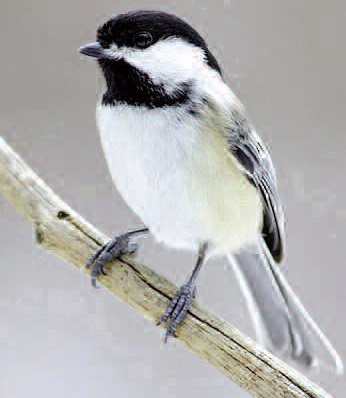
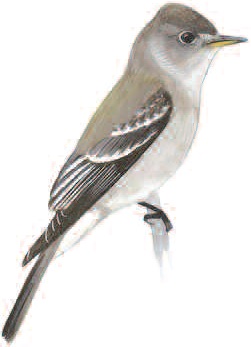
black-capped chickadee
Chickadees are permanent residents. They do not migrate in winter, other than possibly moving south within their range. During winter, they often flock together, and will forage as a group. While flocking, they create a social hierarchy, Males rank over females and older birds over juveniles.
They usually sleep in vegetation or in cavities. I guess this particular chickadee liked the looks of that hole in what it may think is part of the tree.
Black-capped chickadees are monogamous, and males contribute greatly to reproduction. During the incubation period, the male will feed its partner. When the nestlings hatch, males are the primary provider. However, as the young get older the female takes over those responsibilities. They breed between April and June. Females prefer dominant males.
The black-capped chickadee is the state bird of both Maine and Massachusetts, and the Canadian province of New Brunswick, which borders Maine.
The International Union for Conservation of Nature (IUCN) classifies the black-capped chickadee as least concern due to its widespread distribution, and large population.
But, what disturbed me was the sighting of a blue jay in the area of the bird house on Monday. We haven’t seen the chickadee since.
Blue jays are known to attack or kill smaller birds. They are extremely territorial birds and will even show aggression towards humans if they come too close to their nest. Additionally, blue jays may raid other birds’ nests, stealing eggs, chicks or simply taking over the nest. We hope that was not the fate of that little chickadee that we have enjoyed watching for those couple of days.
Of course, with the rain we had on Monday, let’s just hope the chickadee had enough sense to stay out of the rain.
 SCORES & OUTDOORS
 The fish had disappeared, just as quickly as it had appeared. Strange to say the least.