Covers towns roughly within 50 miles of Augusta.

EVENTS: KPAC announces rehearsal sessions

The Kennebec Performing Arts Company (KPAC) is pleased to announce its rehearsal and concert schedule for the 2025-2026 season. The KPAC Wind Ensemble and Choir will once again be under the direction of John Neal, while the organization welcomes Russell Caverly as the new director of the KPAC Jazz Band.

In preparation for the KPAC Holiday Concerts on December 5, 7 p.m., at Winthrop Performing Arts Center and December 6, 5 p.m., at Cony High School, rehearsals will begin as follows:

• Choir: Monday, August 25, at 6:30 p.m., at Hope Baptist Church, 726 Western Ave, Manchester, ME 04351.
• Jazz Band: Tuesday, September 2, at 5:45 p.m., in the chorus room, at Cony High School, Pierce Drive, Augusta, ME 04330.
• Wind Ensemble: Tuesday, September 2, at 7 p.m., in the band room, at Cony High School, Augusta, ME.

No preregistration is required for participation.

KPAC invites experienced and committed musicians to join its ensembles, with open enrollment continuing through September. From rehearsal to performance, KPAC musicians strive for the highest standards of musical excellence, rehearsal etiquette, and dedication. All vocalists and instrumentalists must be able to read music and demonstrate proficiency in the technical aspects of performance.

“We are excited to welcome both returning and new musicians to another fantastic season of music-making,” said John Neal, KPAC Wind Ensemble and Choir Director. For more information, please emailkpac.maine@ gmail.com or visit facebook.com/ KennebecPerformingArtsCompany or www.kennebecperformingartscompany.com.

EVENTS: Great Carrying Place Portage

Portage Trail Hike Offered by The Arnold Expedition Historical Society

This year commemorates the 250th anniversary of Benedict Arnold’s march through the Maine wilderness in an attempt to capture Québec. To honor this daring journey, the Arnold Expedition Historical Society (AEHS) is offering three guided hikes along a section of the Arnold Trail to Québec, known as the “Great Carrying Place Portage Trail,” retracing the steps of Arnold’s 1,000-man army, on Saturday, August 16; Saturday, September 27; and Saturday, October 18, 2025. Arnold and Native Americans before him used the portage trail to travel between the Kennebec River and the Dead River, avoiding 18 miles of dangerous white water and several days of travel.

Each hike is limited to 20 participants on a first-come, first-served basis.

Registration ends August 13, 2025.

The hikes will cover about five miles of the Great Carrying Place Portage Trail – from the Kennebec River to Middle Carry Pond. Along the way, AEHS members will describe the Herculean effort by soldiers to move a hundred tons of supplies to the Dead River. Once at Middle Carry Pond, an AEHS member will lead a discussion on the challenges ahead for the expeditionary force. A replica of a bateau used by the expedition will also be displayed. A shuttle will be available to take participants back to their vehicles.

For more details and the reservation form, please visit the Arnold Expedition Historical Society Facebook page AEHS1775.

Questions about the hike can be directed to Norm Kalloch at pondstream@yahoo.com.

Up and Down the Kennebec Valley: Women doctors in central Kennebec Valley

Gertrude Emma Heath’s home, in Farmingdale, circa 1850.

by Mary Grow

In the course of collecting information on the doctors included in last week’s article about the central Kennebec Valley (and other places), your writer reviewed lists in Henry Kingsbury’s Kennebec County history and Rev. Edwin Carey Whittemore’s Waterville history.

Each book has a chapter on the medical profession in the 19th century. Kingsbury’s includes a list of 200 or more doctors, Whittemore’s almost 50 (with duplicates, of course). All the Waterville doctors named were men.

Kingsbury listed four women (in alphabetical order; your writer has used the same arrangement). Two were from Gardiner, one was from China and one was from Randolph, across the Kennebec from Gardiner. He did not include Martha Ballard, so he was not talking about midwives, though he identified two of his subjects as both midwives and doctors.

Your writer was intrigued enough to seek more information on these women. She succeeded, at least partly, with three of the four, thanks to the resources of the internet, and now shares her findings.

Only Gertrude Heath was identified as a doctor by any source other than Kingsbury. As with last week’s topics, these stories wander outside the central Kennebec Valley. Again, homeopathic medicine is mentioned.

* * * * * *

Gertrude Emma Heath’s information comes from multiple on-line sources, including a genealogy, dated 1909, and a website called buildings of New England, which has an undated photograph of her 1850 Gothic Revival house in Farmingdale.

The writer of the latter site commented: “It is amazing learning stories about such strong women, when at the time, women medical practitioners were almost unheard of and women were decades away from earning the right to vote.”

The genealogy says Heath was the granddaughter of a doctor named Asa Heath. Her father, Alvan M. C. Heath (born in 1828), was “a printer by trade and newspaper editor by principal occupation.”

In the Civil War, Alvan Heath was a corporal in the 16th Maine Infantry. He was killed December 16, 1862, during the battle of Fredericksburg, “leaving his widow Sarah to run the family affairs.” Sarah was the former Sarah H. Philbrook (July 23, 1831 – Aug. 7, 1915).

Alvan and Sarah had three sons and one daughter: Herbert M., born Aug. 27, 1853, a prominent Augusta lawyer and politician; Willis K., born Feb. 12, 1855; Dr. Frederick C., born in 1857 and in 1909 practicing medicine in Indianapolis, Indiana; and Dr. Gertrude E., born Jan. 20, 1859, in Gardiner (or, according to Find a Grave, in Windsor).

Gertrude Heath attended local schools, where she reportedly did well, and, the New England buildings site says, went to Hahnemann Medical College – not in Philadelphia, where so many of the Pulsifers discussed last week were trained in homeopathic medicine, but in Chicago.

(There was indeed another Hahnemann Medical College, in Chicago. It was chartered in 1855, opened in 1860, and began admitting women in 1871. Its website says in 1872, six of 76 students were women; by 1889, 51 women were among 312 students. The college closed around 1921.)

Heath took “special courses” at Hahnemann and got her M. D. degree in 1883 (Kingsbury specified in March) or 1884 (Find a Grave). She started practice in Chicago in 1884, returned to Gardiner the same year, and not long afterwards “accepted a position at the Maine State Hospital, at Augusta, where she specialized in eye and ear conditions.”

(The Maine State Hospital was one of several successive names for the insane asylum on the east bank of the Kennebec River.)

Find a Grave calls Heath the State Hospital’s second assistant physician for seven years. This site says she was also a staff doctor at the Gardiner hospital and for four years Gardiner’s school physician.

Several sources say she continued her private practice while doing her public jobs. In 1892, Kingsbury wrote, she was in practice in Gardiner, with a partner named Huldah Potter (of whom more later).

Another website says Heath headed the local Red Cross branch in the 1910s (“during World War I,” according to Find a Grave). This writer described her as a “respected senior doctor,” who was listed in a 1928 book on important Maine people as widely honored and beloved.

Find a Grave calls her “an active member of the Maine Homeopathic Society.”

Heath’s other career was as a poet, primarily a writer of children’s poems. The Maine State Library held an exhibit of her poetry in the 1920s, “describing her work ‘of special value to Maine people.'”

Titles of Heath’s poetry collections include Rhymes and Jingles for a Good Child (1897) and Sing, Little Birdie and When All the Birds Begin to Sing (both published in 1928). In 1918, Forgotten Books republished her book titled The Madonna and the Christ-Child: Legends and Lyrics, a “collection of poetry and songs” first published in the “late nineteenth century.”

She also edited and arranged what appears to be an autobiography by her older brother, Herbert, titled A Son of Maine: Herbert Milton Heath, published in Augusta in 1916. Herbert died Aug. 18, 1912.

Gertrude Heath died in Gardiner on Nov. 23, 1935, aged 76. She is buried in Gardiner’s Oak Grove cemetery. The eight other Heaths there include her father, her mother and her brother, Willis, who died Oct. 10, 1927, in Farmingdale.

* * * * * *

Dr. Huldah M. Potter, Dr. Heath’s partner for several years, has much less information on line. Find a Grave offers the most your writer found. It does not identify her as a doctor, and, oddly, it lacks information on where she is buried.

Find a Grave says she was born Huldah McArthur in March 1838, in Parsonsfield, in York County. Her parents were John and Huldah (Dalton) McArthur. Educational records are in Augusta, then at Congregational Academy (wherever that was) and Gorham Academy.

The McArthur family might have been in Augusta by 1850. In 1868, Find a Grave says, Huldah McArthur married Charles F. Potter; he left her a widow in less than a year.

A brief genealogical entry in James North’s Augusta history says Charles Fox Potter was born Jan. 29, 1821 (Find a Grave says Jan. 25, 1821). North wrote that he was an Augusta druggist and for some years a “Pension Agent.”

(A pension agent was probably a local representative of the federal Bureau of Pensions, created in 1832, first as part of the War Department and after 1849 as part of the Department of the Interior. Its responsibilities were to determine veterans’ eligibility for pensions and to distribute them.

(Wikipedia says, “In 1896, pensions accounted for 40% of all federal spending as the Bureau of Pensions provided monthly funds that averaged $12 to 750,000 veterans, and 222,000 dependents, especially widows.” As Civil War veterans died in the 20th century, the bureau became smaller. In 1930, President Herbert Hoover integrated it into the Veterans Administration.)

Charles E. Nash, in his chapters on Augusta in Kingsbury’s history, named Charles F. Potter as the fifth proprietor of the Craig drug store, founded in January 1828, on Augusta’s Market Square. In May 1865, Nash said, a former clerk bought part of Potter’s interest; “shortly before the fire of 1865,” he bought the rest.

(The fire, on Sept. 17, 1865, destroyed about 100 buildings, wiping out most of downtown.)

Also, North said, Fox was the “first subscriber in Augusta to the first seven-thirty loan of the government.”

(The federal 7-30 loan program was a bond sale in 1864 and 1865, to raise funds to continue the Civil War. An on-line summary of a promotion for the bonds cites their interest rate, tax-exempt status and support for Union soldiers as reasons patriotic Northerners should buy them.)

According to North, Charles and Huldah married in 1867 (not 1868) and Charles died March 23 of that year (as previous research has shown, a year’s discrepancy in dates is not unusual).

Charles is buried in Augusta’s Forest Grove cemetery. Find a Grave lists his parents and siblings, but no spouse.

Kingsbury’s brief account of Dr. Huldah Potter’s life says she got her medical degree from Boston University in 1877 and was back in Gardiner by 1879, where she partnered with Heath, perhaps for the rest of the century.

An on-line photo of selected pages from an undated history of homeopathy (apparently related to Boston University, since it identifies subjects by graduation year) lists Huldah McArthur Potter’s death date as Oct. 16, 1904. Find a Grave says she died of diabetes.

* * * * * *

The third female doctor on Kingsbury’s list was “Mrs. Ward.” He identified her as a midwife and physician in China, Maine, before 1808, when, he said, the first (male) doctor settled in the town.

Numerous men and women named Ward lived in China in the 19th century. A review of the Ward genealogy in the China history found no woman identified as a medical practitioner of any sort.

* * * * * *

Anna (Huston) Winslow (Mrs. James Winslow), of Randolph, was a very early “physician and midwife,” according to Kingsbury, who wrote that the family settled there in 1763. (Randolph was part of Pittston until March 1887.)

“She was widely known as ‘Granny Winslow,’ and practiced from Bath to Augusta” Kingsbury said. As with Huldah Potter, your writer found no other source that called Winslow a doctor.

FamilySearch provides a summary of the life of Anna McCausland Huston, daughter of James and Mary McCausland, born in 1734 in Falmouth (near Portland). An on-line genealogy explains “Huston”; she was first married to, and left a widow, by a man named Isaac Huston.

Ancestry.com lists Isaac Huston, born in 1730, in Falmouth, whose wife was Anna McCausland Huston (1734 – 1827). Isaac Huston died in Falmouth, Oct. 26, 1756, according to this source.

FamilySearch says it was on July 5, 1753 (another not unusual discrepancy in dates), that Anna McCausland Huston married James Winslow (born Aug. 6, 1725, in Freetown, Massachusetts), in Falmouth. The couple had at least six sons and three daughters between 1754 and 1785.

This source says the couple’s first two children were born in Broadbay (or Broad Bay), Maine (an old name for Waldoboro, which is about 25 miles east of Pittston), in 1754 (twins?).

The genealogy says “Indian troubles” led the Winslows to move to Pittston in the fall of 1760. They were among the earliest settlers: “Anna and daughter Sarah were the first white females in Pittston,” and son Jonathan, born March 23, 1761, was the first white child born in the town.

Jonathan was the first of six children born between 1761 and 1774 in Pittston, according to FamilySearch. The youngest son was born in Kingfield (about 70 miles north of Pittston), around 1785 (his mother was 52 and his father 61, FamilySearch says).

FamilySearch says Anna died in Farmington (about 20 miles south of Kingfield) on Feb. 15, 1827, aged 93. Her husband had died Nov. 16, 1802, also in Farmington.

Main sources

Kingsbury, Henry D., ed., Illustrated History of Kennebec County Maine 1625-1892 (1892)

Websites, miscellaneous.

PHOTO: Up close!

Deb Dolan photographed this damsel fly up close, while being stared down.

Local students receive Worthington Scholarships

The Worthington Scholarship Foundation (WSF) is delighted to announce that 1,000 graduating seniors from high schools across Maine were awarded the Worthington Scholarship. The Foundation is committed to increasing college accessibility by reducing financial barriers and connecting scholars with resources that will aid them in their college journey.

“This Foundation was created with a simple vision: to support the completion of post-secondary education in Maine,” said Bev Worthington, Co-Founder of WSF. “In just 15 years, we’ve grown from awarding 10 scholarships to 1,000. We are honored to be part of our scholars’ college journey and know that they have what it takes to succeed.”

The Worthington Scholarship is open to students graduating from one of Maine’s 134 public high schools who plan to attend one of the Foundation’s partnering colleges in Maine. Awardees have shown a strong commitment to their education and a clear desire to invest in their future.

Each Worthington Scholar receives up to $20,000 in support to attend a Worthington-eligible Maine-based college.

This year’s local scholarship recipients are:

Carrabec High School: Kailie Ebneter, Brady Goguen, Machaon Pierce, Macie Plourde, Seth Price, Desmond Robinson, Josephine Scheve, Ian Smith, and Brooks Sousa.

Cony Middle High School: Aya Abdulmohsin, Jedadiah Billings, Carter Blanche, Ian Brewer, Emma Buccellato, Kassidy Delesline, Rachel Fongemie, Penelope Fyfe, Loralie Grady, Hailey Johnson , Kaydence Mills, Allie Reichard, Kaylee Rhynd, Matthew Serrano, Amiel Sookma, Juliannah Soper, and Ethan Vose.

Erskine Academy: Noah Bechard, Jayda Bickford, Madison Cochran, Trinity DeGreenia, Brady Desmond, Aidan Durgin, Josiah Fitzgerald, Kenneth Fredette, Serena Hotham, Kaiden Kronillis, Jade McCollett, and Carter Rau.

Lawrence High School: Kylie Delile, Wyatt DeMott, Stella-moon Devine, Broden Eaton-Foster, Gabriel Fairbrother, Paige Goodwin, Harley Greatorex, Ashlee Jarvis, Ryan Lea, Matthew Menchen, Emma Mills, Nadia Morrison, Madisyn Niles, Kallie Richards, Alina Rodrigue’Butler , Kaylie Smith, Landon Vigue, Alyssa Welch, and Deven Young.

Madison Jr. Sr. High School: Jeason Almeida, Avea Daskoski, Bryan Donnelly, Leila Dunphy, Ethan Linkletter, Aurora Norsworthy, Hailey Poissonnier, and Carmyn Young.

Maine Academy of Natural Sciences: Sophia Barrientos, Logan Dube, Michael Golden, Nicholas Hewett, and Rose Jadamec.

Overman Academy: Gabrien Curtis

Skowhegan Area High School: Myla Brown, Jorja Brown, Emi Brusa, Delena Cabral, Rae Corson, MacKenzie Dawe, Joseph Frappier-Nadeau, Meraina Furbush, Brooklyn Goodridge, Cody Hardy, Twyla Hodgdon-Wagg, Cailyn McKechnie, Levi Nichols, Samuel Philpot, Michela Provost, Kaden Salsbury, and Drake Turcotte.

Upper Kennebec Valley High School: Emma Belanger, and Madeline Hill.

Waterville Senior High School: Abigail Albert, Dustin Bearce, Gage Chamberlain, Maxwell Field, Jeffrey Flees, Garrett Gendreau, Fynley Grubbs, Nivonsenga Hawyari­mana, Jeffrey Ogori, Mischa Pelletier, Kaethe Rice, Patrick Robinson, and Cormac Wilcox.

Winslow High School: Seth Bard, Malyn Beaster, KayLynn Beaulieu, Adeline Blackstone, Stella Brunelle, Haileigh Camp, David Cooper, Izaiah Costigan, Michael Dellinger, Kyrah Denis, Jessi Dunn, Makayla Ellis, Jacob Garcia, Zoe Gorman, Amy Jones, Kyran Kinrade, Maya Lavallee, Meghan Mahoney, Abigail McCaslin, Liam McPherson, Kyri Meak, Paige Owen, Brady Poulin, Ava Prickett, Kalia Reffett, Braden Rodrigue, Sierra Sharp, Allexandriea Small, Jacqueline Soucy, Sophia Sullivan, Maya Veilleux, Tealah Ward, and Brody Willette.

Mitchell Institute announces 13 new Mitchell Scholars from Somerset County (2025)

Thirteen recent high school graduates from Somerset County have been named 2025 Mitchell Scholars by the Mitchell Institute. The 2025 scholars join more than 3,800 past recipients who have been unlocking their potential, having successful college experiences and contributing to the vitality of their communities since 1995. Students receive a $10,000 scholarship award, along with ongoing personal and professional support to ensure they find success in their journey throughout college and beyond.

These students include: Desmond Robinson – Carrabec High School, Allie Dunning – Forest Hills Consolidated School, Addy Battis – Lawrence High School, Harley Greatorex – Lawrence High School, Kallie Richards – Lawrence High School, Bryan Donnelly – Madison Area Memorial High School, Aurora Norsworthy – Madison Area Memorial High School, Sophia Barrientos – Marine Academy of Natural Sciences, Johnathan Batchelder – Maine Academy of Natural Sciences, Grace Curtis – Overman Academy, Cailyn McKechnie – Skowhegan Area High School, Michela Provost – Skowhegan Area High School, and Madeline Hill – Upper Kennebec Valley Memorial High School.

“Senator Mitchell realized a bold vision when he created the Mitchell Institute – to increase the likelihood that young people from every community in Maine will aspire to, pursue, and achieve a college education,” said Jared Cash, CEO. “In our 30th year, his vision is more important than ever before. We’re proud to support these remarkable young people as they begin journeys that will benefit Maine for generations to come.”

Each year the Mitchell Institute receives more than 1,600 applications and is tasked with choosing at least one student from every public school in the state. Scholars are chosen with a balanced view of their financial needs, academic achievement, and community impact.

This year marks the largest class in Mitchell’s 30-year history – with 200 Ssholars in total.

But this year was unique in more ways than just the numbers: “Every part of the Mitchell community had a hand in choosing who made up the incoming class,” said Casey Near, Scholarship Director. “I was joined by our Access Ambassadors to help promote the Mitchell Institute on visits to high schools, and Alumni were able to read applications for the first time ever, along with the staff and board to help select recipients.”

The benefits of this unique program can be proven through its statistics: Scholars graduate college at a rate 30 percent higher than the national average; 81 percent are working in career-related jobs; 29 percent report they hold a master’s degree; 10 percent hold either a doctorate, JD, or an MBA; and 71 percent say access to the Mitchell Board, donors, and alumni network have had a positive impact on their careers.

The Mitchell Institute unlocks the potential of Maine college students so that they can find success in college and contribute to the vitality of their communities.

11th annual Cruisin’ for a Cure car show nets over $18,000 for Maine Childen’s Cancer Program

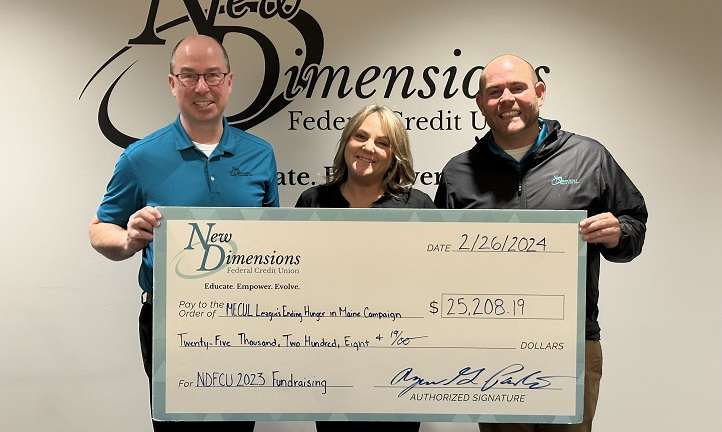
The official check presentation for this year’s event took place on July 15, at the Silver Street branch of New Dimensions FCU. It included, from left to right, Ed Thompson, Sandy Isaac, Ashley Green (MCCP), Tammy Poissonnier, Ryan Poulin (CEO), Dani Farmer, Molly Herman (MCCP), Angela Hallee, and Sharon Storti. (contributed photo)

by Tammy Poissonnier

The 11th Annual Cruisin’ for a Cure Car Show, held on June 7, 2025, successfully raised $18,226.49 for the Maine Children’s Cancer Program (MCCP). Despite challenging weather conditions, over 100 car owners showcased their vehicles, making this year’s event another impactful milestone in the fight against childhood cancer.

Although the turnout was smaller than usual, the car show still made a significant difference. One of the highlights of the day was the special guest, Shelby Belanger, whose son Asher was a recipient of MCCP funds during his battle with cancer. Asher, who said he “loves cars”, was able to see so many of his favorites at the car show, and his story deeply resonated with the attendees. Shelby spoke about how the MCCP supported her family during their difficult journey, leaving everyone in the crowd moved by the program’s importance. Her heartfelt words reminded attendees of the critical role these funds play in helping Maine families.

Since its inception, the Cruisin’ for a Cure Car Show has raised an impressive $208,313.55 for MCCP, demonstrating the community’s remarkable generosity and the ongoing commitment to supporting children in need.

For more information or to get involved in future events, please visit https://www.facebook.com/cruisinn4acure/.

PHOTO: Sign of the times

Making hay while the sun is shining. (photo by Gary Mazoki)

LETTERS: Nominations for awards open

To the editor:

With so many older Mainers making a difference in our communities every day, AARP Maine is proud to once again honor one outstanding individual through the annual Andrus Award for Community Service. I’m writing to encourage Mainers to nominate someone age 50 or older who has gone above and beyond in serving others. The nomination deadline is July 15, 2025.

This award is AARP’s most prestigious volunteer honor and is named after Dr. Ethel Percy Andrus who founded AARP at age 73. It celebrates people whose selfless work has improved lives and inspired those around them. Nominees do not have to be AARP members or volunteers; they just need to live in Maine and have made a meaningful impact through unpaid service.

As a volunteer myself, I’ve met so many people who give their time quietly, never asking for recognition. Whether delivering meals, mentoring youth, helping neighbors age safely at home, or running community programs, their acts of kindness often go unnoticed. That’s why this award matters, and it shines a light on those who lead with heart and action.

Last year’s recipient, Pamela Partridge, of North Anson, is a perfect example. She is a retired educator who continues to give back, improving lives and inspiring others long after retirement. I believe there are many more Mainers like her, and they deserve to be seen and celebrated.

If you know someone who you feel would be worthy of this award, please take a few moments today to nominate them. Details and nomination forms are available at www.aarp.org/andrusaward.

Let’s celebrate the people who make Maine a better, stronger, and more compassionate place for all of us.

Dr. Erica Magnus
AARP Maine, Communications Volunteer
Windham

Up and Down the Kennebec Valley: Early surveyors

by Mary Grow

As promised, the next articles in this series will introduce some of the important surveyors in the central Kennebec Valley as Massachusetts proprietors sold lots – mostly pieces of land they had never seen – to settlers, and other people began lumbering, trapping and farming without the formality of buying a lot.

Readers should remember that Kennebec Company, Kennebec Proprietors, Plymouth Company and Plymouth Proprietors all mean the same organization of Massachusetts businessmen who owned most of the Kennebec Valley. Different local historians preferred different names.

* * * * * *

European settlers had moved into the lower Kennebec Valley in the first half of the 18th century. Once the threat from the Natives and their French supporters ended in the 1760s, interest in upriver lands increased. The Kennebec Proprietors hired Nathan Winslow to survey both sides of the river from Chelsea, south of Augusta, to the north line of present-day Vassalboro, dividing the land for three miles inland into lots.

Multiple historians wrote that Winslow was hired in 1761 and dated his completed survey June 17, 1761. Your writer found in the on-line Maine Memory Network a statement that Winslow covered Pittston, Hallowell, Vassalboro (then including Sidney) and “Some in Winslow town and finished his Survey and made his plan and dated it the 17th of June 1761.”

This statement continued: “all those Surveys was made for the Kennebeck proprietors hath been made from may 1750 & Continually one after another: in Succession as of oft as they Could be.” If this information is accurate, the implication is that Winslow’s work took 11 seasons (but see below for his contradictory birthdate).

In their town histories, Alice Hammond and James North each reproduced the parts of the survey that became Sidney and Augusta, respectively. Winslow laid out three tiers or ranges of lots, each a mile deep, with an eight-rod (132-foot) space for roads between the each tier.

(Winslow’s range roads or rangeways were laid out as straight lines, but might in practice vary with the terrain. Some Kennebec Valley deeds still refer to them; and Waterville has streets named First Rangeway, roughly parallel to the Kennebec, and Second Rangeway, farther west.)

The 100-acre lots with river frontage were 50 rods (825 feet) wide. (At least one source says each lot was 125 acres; the math disagrees.) The maps show Range 2 lots as three times the width (150 rods, or 2,475 feet); and Range 3 lots 75 rods (1,237.5 feet) wide.

Along the river, one of every three lots was reserved for the Proprietors and marked with a P on the plans. Settlers’ lots were marked S. All of the big Range 2 lots were for Proprietors and all of Range 3 for settlers.

Winslow numbered the lots from south to north: in Augusta, on the east side of the river the lots run from 1 to 50, but on the west side, where the survey starts farther upriver, the northernmost lot is 34.

Vassalboro historian Alma Pierce Robbins’ account of Winslow’s survey on the east bank of the river was less detailed, but comparable. She, too, wrote of three tiers of lots, adding that Vassalboro included riverside lots 51 to 102 on the east bank and 35 to 82 on the west (later Sidney) bank. Most of Seven Mile Pond (now Webber Pond in Vassalboro) was in the third tier.

Rev. Edwin Carey Whittemore, in his history of Waterville, said that a March 12, 1766, grant from the Plymouth Company gave six named men 18,600 acres “covering the present Winslow,” with conditions.

Within four years, the new landowners were to have 50 settlers, at least 25 of them with their families, and 50 houses “not less than twenty feet square and seven feet studd [high?] each.” Each settler was to have cleared and ready for mowing at least five acres adjoining his house.

Robbins said the Proprietors gave settlers three years to clear five acres and build a 20-by-20-foot house, and required the settler or his heirs to occupy the house for another seven years. In addition, for 10 years each settler was to work two days a year on town roads and another two days for the church or the minister’s house.

These requirements were common for Kennebec Valley land grants. Their effects seem to have varied.

Whittemore claimed that the plan for (future) Winslow “was the only one to succeed of many similar propositions.” However, the 1761 plan in North’s Augusta history has owners’ names, rather than numbers, on most lots; and the China bicentennial history says that “between 1762 and 1766 most of these riverside lots [none in China, which is inland from the river] were taken up.”

For the April 2011 issue of the Sidney Historical Society’s newsletter, Polly Furber wrote an article on some of the early deeds in the town, based on Nathan Winslow’s 1761 survey. Having done that research, she decided to find out more about the surveyor, commenting that “I have never seen his name mentioned in any local history.”

Furber found that Winslow was the son of Nathan and Charity (Hall) Winslow, born April 1, 1743, in Falmouth – therefore, she pointed out, only 18 in 1761. He lived all or most of his life in Falmouth; Furber found a Quaker document recording the births of his five sons and five daughters there, between 1765 and 1785.

He married in 1764, probably to Jane Crane (according to multiple sites, including the list of his children in Quaker records; Furber called her Judith). FamilySearch says she died in 1805. In 1807, Furber found, he married again, a woman name Mary Vinal from Dresden.

FamilySearch adds that Winslow “registered for military service in 1778.” He was still actively surveying into the 1800s. FamilySearch dates his death Nov. 7, 1820, aged 77.

An on-line genealogy of a remotely-related family named Nagel says Winslow died Nov 7, 1826 (not 1820), in Falmouth. This source says his wife, Jane Crane, was born Nov. 12, 1742, in Sagadahoc (in the lower Kennebec Valley) and died March 30, 1805, in Windham.

* * * * * *

Surveyor Ephraim Ballard is mentioned in several early accounts. He was born May 6 or May 17, 1725, in Oxford, Massachusetts (or in Billerica and moved with his parents to Oxford in 1726). On Dec. 19, 1754, in Oxford, he married Martha Moore (born Feb. 9, 1735), author of the well-known diary of life as a midwife in the central Kennebec Valley from 1785 to 1812.

In 1775, Ephraim (and presumably his family) came to Fort Halifax. James North wrote in his 1870 Augusta history that on Oct. 15, 1777 (another source says 1776), Ballard moved into surveyor John Jones’ former house in Augusta (then Hallowell) and took over Jones’ mills, which Jones had abandoned because of his Loyalist sympathies.

Most sources wonder if Ballard, too, was a Loyalist. North thought not, citing 200 British pounds given him from the town “for his contribution to the revolutionary cause” in 1780, as well as his election to town offices.

He was a Hallowell selectman from 1784 through 1787. Later, he was the town’s tax collector, imprisoned in 1804 for failing to collect all the taxes he should have. Maine An Encyclopedia calls him a “prominent local resident” and says he is “frequently mentioned in the town’s records.”

This source calls Ballard one of the Proprietors’ “principal surveyors” and says, “His name appears on hundreds of maps in the area, and of such far-flung locations as Canaan, Lincoln Plantation, Bangor, Magalloway Plantation, Eustis, and Dover-Foxcroft.”

One such map, found on line, is dated 1794 and shows “the few county roads and three church parishes of early Hallowell,” before the two northern parishes became a separate town – eventually the City of Augusta — in 1797. A recent comment on the map says, “Mr. Ballard drew this map on the same kind of paper that Martha Ballard cut and folded to make her diary.”

Ballard is named as the surveyor of part of Albion, an area Kingsbury said the Kennebec Proprietors had given to Nathan Winslow. North wrote that while Ballard was surveying in Balltown (the area that later became Jefferson and Whitefield), armed men (perhaps settlers without deeds?) stole his surveying instruments and papers and drove him away.

One survey North described was in 1796, for the Plymouth Company, tracing a stream that flows into the Kennebec in Gardiner. In June, Ballard reported he had “ascertained the general course of the Kennebec from ‘Cobbossee stream’ down to the ‘chops'”; had found “the utmost limits of Cobbosseecontee towards the western ocean”; and had run a line from that point east-southeast to the Kennebec.

The “utmost limits” of the stream Ballard defined as the most southern point at which water was running into it. North said he was paid seven pounds, 10 shillings for this job.

Also in 1796, North wrote, the Commonwealth of Massachusetts hired Ballard to survey potential settlements on the Penobscot, in what became Hampden and Bangor.

One of Ballard’s surveys created the Ballard Line. As Millard Howard explained in his 2015 Palermo history, in the area that became Palermo the Kennebec Proprietors’ claim overlapped with a separate land grant called the Waldo Patent, owned in 1795 by General Henry Knox.

In June 1795, Knox and the Proprietors agreed on a division and hired Ballard to implement it on the ground. The Ballard Line is close to the eastern border of Palermo, Howard wrote, “leaving most of the town to the Kennebec Proprietors.”

Martha Ballard

Martha Ballard’s diary recorded some of her husband’s work. (Excerpts were included in a Feb. 16, 2023, article in this series in The Town Line.)

On Aug. 23, 1796, she said, a committee (unspecified) hired him to go to Dresden “to lay out a road to the point.” After preparations that included bringing “two birch cannoes [her spelling] to our shore,” he left at 10 a.m. Sept. 5; he came home Oct. 13.

Martha’s diary shows him actively surveying in following years, for the Proprietors, for individual settlers and sometimes laying out new roads for a town.

In mid-April, 1801, she recorded that he was dividing 2,000 acres somewhere between the Kennebec and the Penobscot. In late June that year he had a job in Bowdoinham. In September, he was working in Readfield, and in November, in Fairfield. December 22 he spent running the Sidney-Augusta town line.

In 1803, Martha wrote that he “sett [her spelling] out to go to Davis Town” on July 26; he returned on Sept. 27. (The length of time he was away suggests he could have been working in Maine’s current Davis Town, in Franklin County north of Rangeley and Mooselookmeguntick lakes, almost 100 miles from Augusta.)

Besides being a surveyor, Ballard ran the Jones mills he took over during the Revolution, North says until the fall of 1791. Other sources mention his working as a builder and a farmer.

The Ballards had three sons and two, three or four daughters (sources disagree), born between 1756 and 1779. At least one daughter, maybe two or three, died in childhood in a June 1769 diphtheria epidemic in Oxford.

On Nov. 1, 1799, North said, Ephraim and Martha moved to their son Jonathan’s riverside farm about a mile north of Augusta’s center.

Most sources say Martha Ballard died in May 1812, but North quoted an Aug. 7 1812, diary entry and wrote that she died within the next three weeks. Ephraim died January 7, 1821. Find a Grave says they “were buried in Augusta in a small family burial ground on…[their] son Jonathan’s property. The cemetery was later plowed up to plant crops.”

Main sources

Hammond, Alice, History of Sidney Maine 1792-1992 (1992).
Howard, Millard, An Introduction to the Early History of Palermo, Maine (second edition, December 2015).
North, James W., The History of Augusta (1870).
Robbins, Alma Pierce, History of Vassalborough Maine 1771 1971 n.d. (1971).
Ulrich, Laurel Thatcher, A Midwife’s Tale The Life of Martha Ballard, Based on Her Diary, 1785-1812 (1990).

Websites, miscellaneous.