Covers towns roughly within 50 miles of Augusta.

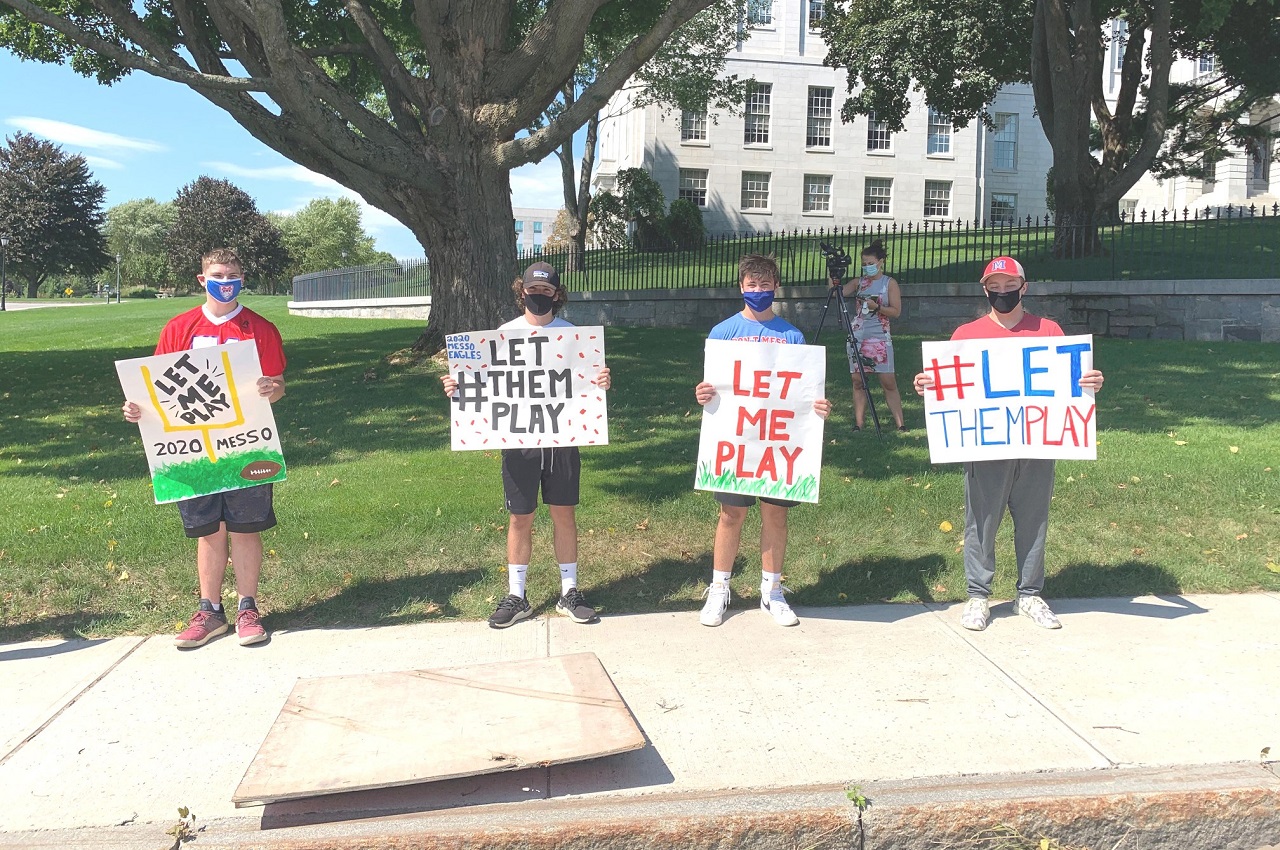
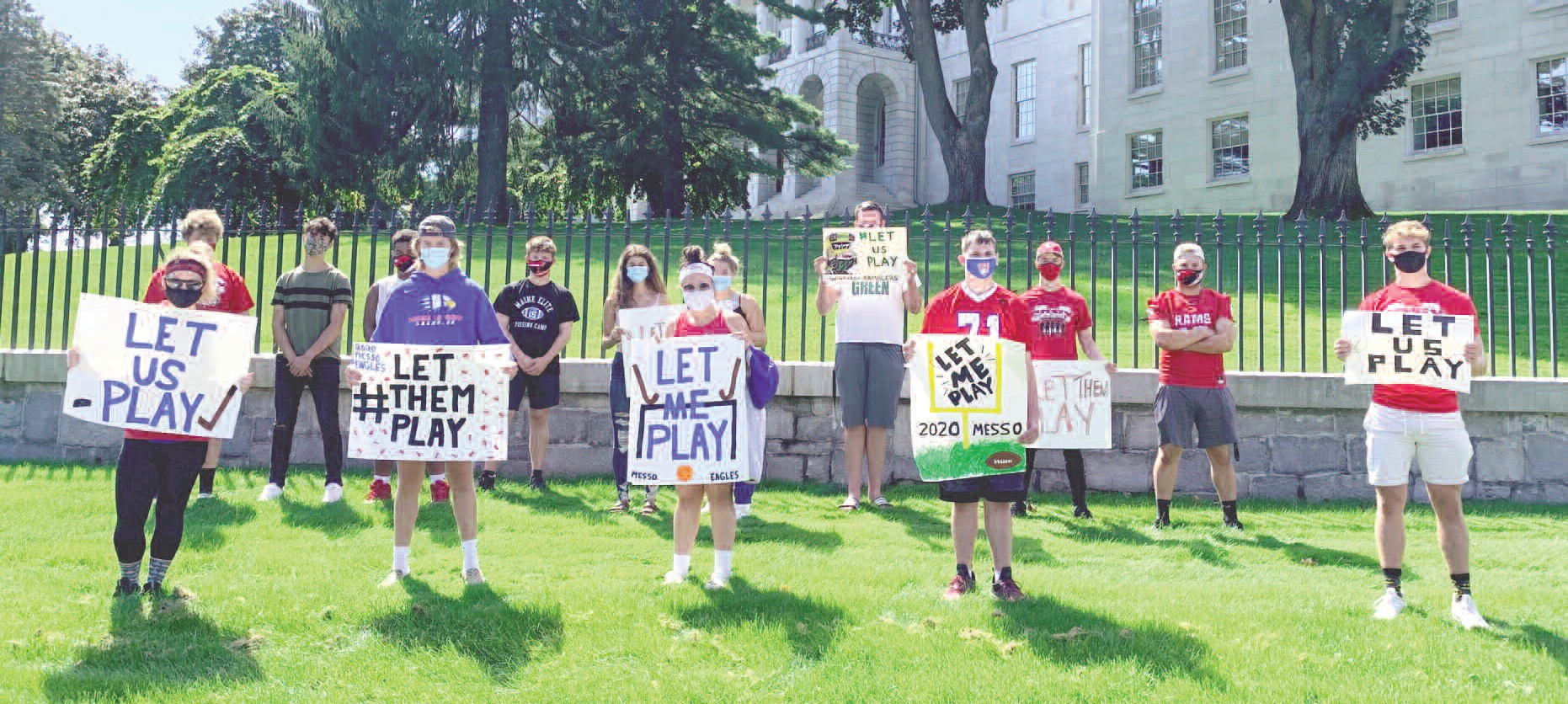
Let Them Play Rally on Labor Day

Members of the Messolonskee football team rallying in Augusta hoping they have a season! (photo by Central Maine Photography)

Messalonskee field hockey team member Jenna Cassani at the Let Them Play Rally. She is a senior this year. (photo by Central Maine Photography)

Messalonskee and Cony High School football team members at the Let Them Play Rally on Labor Day, in Augusta. (photo by Central Maine Photography)

KV tourism council awards sponsorship to Mid-Maine Chamber

Kimberly Lindlof

The Kennebec Valley Tourism Council (KVTC) has awarded Sponsorship Support funds in the amount of $2,500 to the MERGEFIELD Business Mid-Maine Chamber of Commerce for the MERGEFIELD Project Taste of Waterville. This funding will assist in the growth of tourism in Maine’s Kennebec Valley and produce a positive economic impact on the region.

The Chamber received one of six sponsorships awarded as part of the 2020 KVTC marketing partnership program. In total, the 2020 KVTC sponsorship support application requests reached nearly $17,500. The organization was able to fully fund all regional sponsorships to its members this year. KVTC is excited to award local organizations who are helping KVTC promote the Maine’s Kennebec Valley Region as a destination place with their own marketing initiatives.

Mid-Maine Chamber President & CEO Kimberly Lindlof said she greatly appreciates the support of the Kennebec Valley Tourism Council. Kim added, “This grant will assist in allowing us to continue the long tradition of the Taste of Waterville event and to further grow tourism in the central Maine region. The Taste draws large numbers of residents and visitors, showcasing the rich diversity of the area through demonstrations, music/entertainment and food. This year’s event will take place at Head of Falls and will focus on ethnic culture and cuisine, tying into the state’s Bicentennial celebration.”

“KVTC is excited to be able to support local organizations with our 2020 partnership program. These sponsorships help provide funding for key marketing elements including advertising, printing, branding and more,” says Tanya Griffeth, executive director of the KVTC. “This year has been difficult for our signature events, with many events canceled and/or had to change their strategy; we are happy to say all but one is scheduled to take place. These funds are dedicated to support marketing efforts in some of the more rural areas in Maine. While established events can rely on word-of-mouth and brand awareness to help drive attendance, new events and destinations have quite a bit of ground to cover to pull visitors from neighboring regions.”

Up and down the Kennebec Valley: Wiscasset, Waterville & Farmington

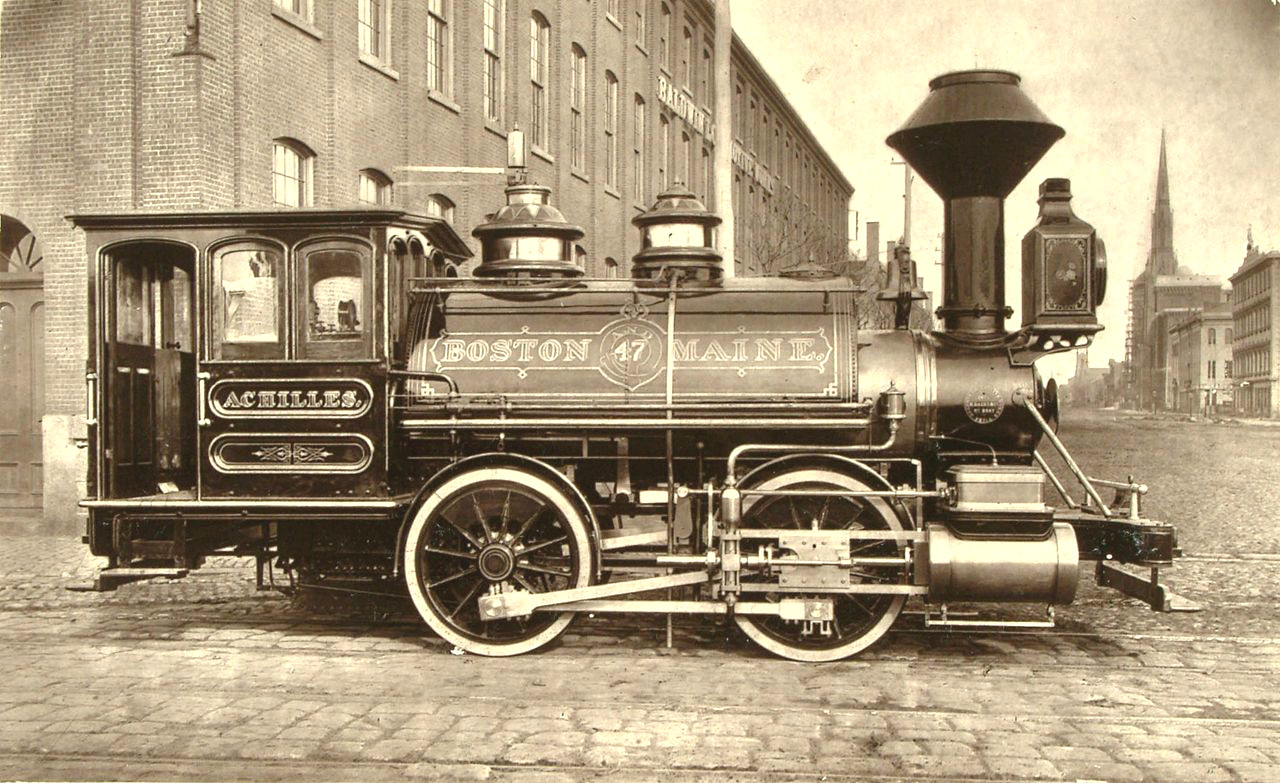
1894 Forney.

by Mary Grow

When railroads first began operating in the United States, different companies used different gauges (width between the tracks). “Standard gauge” ranged from four feet eight-and-a-half inches (imported from Britain, used by the Baltimore & Ohio and Boston & Albany lines, among others) to six feet (used by the Erie and the Lackawanna, among others), and was not definitely established at four feet eight-and-a-half inches until after the Civil War. The war emphasized the need for interconnected rail transportation; the transcontinental railroad was completed on May 10, 1869.

In addition to the standard gauge, there were “narrow-gauge” railroads. According to Ernest Marriner’s Kennebec Yesterdays, a narrow-gauge line could have tracks anywhere from two feet to three-and-a-half feet apart.

Maine, Marriner wrote, was the state with the most narrow-gauge railroads. Linwood Moody wrote a generously illustrated book about them, published in 1959 and entitled The Maine Two-Footers. How many there were depends on when they were counted, because, as with the standard-gauge lines, companies consolidated. Moody is certain, however, that the central Kennebec Valley hosted two: the Kennebec Central, with which he fell in love as a child of 10 or 11, and the one remembered locally as the Wiscasset, Waterville & Farmington.

The Kennebec Central was the shortest narrow-gauge in Maine. It had five miles of track, from Randolph to the Togus veterans’ home in Chelsea, and ran from July 23, 1890, to June 29, 1929. Wikipedia says Randolph had a small station from which stairs led to the covered bridge crossing the Kennebec River to Gardiner.

1894 Baldwin.

During those 39 years, the railroad used four engines, an 1890 Baldwin and three Portlands built between December 1890 and April 1892. The first two were apparently bought new; the Baldwin was scrapped about 1922 and the first Portland about four years later.

The two later Portlands were second-hand, one acquired about 1922 (to replace the Baldwin) from the Bridgton & Saco River line and the other (no date given; probably 1925 or 1926, as it replaced the first Portland) from the Sandy River line. Moody wrote they both went to the Waterville, Wiscasset & Farmington in the early 1930s, after the Kennebec Central closed and as the WW&F in turn was about to go under.

(The Bridgton & Saco operated from 1883 to 1941. The Sandy River started in 1879 and ran until 1908, when it merged into the Sandy River & Rangeley Lakes and ran until the mid-1930s.)

The Kennebec Central engines hauled passenger coaches, open-sided excursion cars, combination passenger and baggage cars, freight cars and coal gondolas. A main purpose of the railroad was to let Civil War veterans get from Togus to Gardiner and their relatives and other visitors from Gardiner to Togus. Both Moody and Wikipedia describe the Sunday afternoon baseball games and concerts that brought crowds of visitors to the veterans’ home grounds.

The railroad’s other use, and probably more dependable income source, was to deliver supplies to Togus, especially the coal that was shipped up the Kennebec to a government-owned facility in Randolph and was used as heating fuel. Therefore, when the government switched the coal-hauling contract to a trucking company, the railroad closed.

Its rolling stock was stored until 1931, when a fire damaged the WW&F engines housed in Wiscasset. Wikipedia says Frank Winter, then the WW&F owner, bought the entire Kennebec Central, brought the engines back into use and sold what trackage and cars he could; the left-overs were carried down the river in the 1936 flood.

The WW&F, also known as the Weak, Weary and Feeble and the Little Wiggler, went through multiple corporate incarnations, according to Moody. It started in Wiscasset because Wiscasset was a major port, and was first chartered in 1854 as the Wiscasset & Québec.

For 40 years, Moody wrote, nobody developed the railroad. In 1894, a group of local entrepreneurs raised funds to start laying track, improving Wiscasset’s docks and connecting the new railroad via a very long trestle across the Sheepscot to the docks and adjoining Maine Central yard.

The railroad’s first engine was an 11-year-old Forney bought from the Sandy River and used to haul work trains with supplies and crews as the line was built. Two Portlands built in November 1894 were the next engines added.

The W&Q tracks went along the Sheepscot River through Sheepscot station, which served Alna, where there was a flag stop, and Sheepscot Village; through Head Tide; past a railroad-owned water tank and gravel pit and across the Sheepscot to Whitefield; thence to North Whitefield and Coopers Mills. Leaving the river, the line continued through Windsor, Weeks Mills, Palermo and China to Albion, which it reached in November 1895.

Moody commented that the typical station was in the countryside a mile or more from the nearest village.

The promoters still had Québec in their vision statements. Moody wrote that tracks were laid from Albion to the point between Burnham and Pittsfield where the W&Q would cross the Maine Central tracks and continue north. In 1897, the Maine Central vetoed the crossing.

Representatives of both lines went to the three-man Maine Railroad Commission. The commissioners ruled that the W&Q could build an overpass; and that while the overpass was being built, the W&Q could install a temporary crossing, called a diamond, if the company could do the job without interfering with Maine Central traffic.

The overpass idea was a non-starter; the ground was too flat.

As Moody told the story, the Maine Central trains, passenger or freight, normally ran about every two hours. W&Q officials hauled in a pre-made diamond and assembled an Italian crew to install it. The foreman waited for the morning Maine Central to go through and signaled the crew to get started. But whoops! here came another Maine Central train. It passed, the crew moved in – and another engine was bearing down on them.

(Moody thought the whole deal, including the commissioners’ role, smelled of fish. He doubted the railroad promoters seriously planned to continue the line to Québec, or would have prospered if they had; wondered why, if they were serious, they didn’t fight harder against the Maine Central; and believed their stockholders were gypped.)

The result was that as of 1897, the main line of the W&Q ran 43-1/2 miles from Wiscasset to Albion, carrying passengers, mail and freight.

The promoters still promised Québec and, Moody wrote, organized two new companies, the Waterville & Wiscasset to connect Weeks Mills via Vassalboro to Winslow and the Franklin, Somerset & Kennebec to continue through Waterville to Farmington.

In 1898 and 1899 most of the line between Weeks Mills and Winslow was finished. But a vital connection in Farmington to the Sandy River line required crossing a piece of land the Maine Central owned; and the Maine Central refused passage. (Moody wondered why the FS&K wasn’t relocated around the Maine Central lot, and suggested the Sandy River directors were unenthusiastic about the proposed connection.)

The result of this second failure was that the W&Q went bankrupt. In 1900, according to the history on the WW&F’s Alna museum website, Leonard Atwood bought the Wiscasset to Albion and the Weeks Mills to Winslow lines, three engines and 60 or more cars, mostly freight cars. He renamed the line the Wiscasset, Waterville & Farmington Railroad, though no one cites evidence he aimed for either Waterville or Farmington.

(An on-line genealogy says Atwood was born in Farmington Falls in 1845, and served two years in the Union navy during the Civil War. His mechanical interests led him to invent elevator machinery that he installed in hotels in the 1870s. After selling his patents to Elisha Graves Otis [founder of the Otis Elevator Company], he moved to Nova Scotia and organized a narrow-gauge railroad south from Yarmouth in the early 1890s, before he became president of the WW&F. He died in 1930.)

By 1902 the WW&F line to Winslow was finished and the new company had a new Forney engine, a new passenger car and a new combination passenger/mail car. In the next few years, as North Vassalboro mills expanded, the Winslow route became the main line. But, Moody wrote, the railroad failed to generate enough income to repay debts, keep up with maintenance and show a profit.

In 1906, W. W. Woolworth Company Vice-President Carson Peck bought the WW&F for $93,000, “after spirited bidding,” the museum’s website says. Peck renamed the company the Wiscasset, Waterville & Farmington Railway (not Railroad); paid off its debts; and bought three classy engines, a Forney from the Bridgton & Saco and two new Baldwins, one designed for freight and one for passenger cars, that were bigger than any the WW&F had owned before.

For another two decades, Peck and after his death in 1915 his heirs ran a slowly-declining business. The decline was partly because cars and trucks took over passenger and freight movement.

The museum history says after the owners started asking for dividend payments in the early 1920s, maintenance and service began to suffer. The line was discontinued from North Vassalboro north to Winslow, passenger service from Weeks Mills to North Vassalboro ended and Wiscasset to Albion was again the main line.

1922 Portland.

By 1926 the Peck heirs were ready to sell the railway. Local people raised the $60,000 asking price, and, Moody wrote, long-time General Manager Sam Sewell continued to run the business. But with profits small or non-existent and service and maintenance still being cut, in 1930 a Palermo lumberman named Frank Winter was able to buy the company for $6,000 (Moody said there was $5,000 in the till, so Winter actually got it for $1,000).

Winter’s main interest was to keep trains running to ship timber from his land. Moody wrote that maintenance focused on engines (including the defunct Kennebec Central’s), flatcars for lumber and the mail car that generated $9,200 a year.

The final trip on the WW&F was on June 15, 1933, when the remaining useable engine, heading coastward from Albion, left the track in Whitefield and slid down the bank toward the Sheepscot. Engineer Earl Keefe and the other three crewmen were unhurt; they continued to Wiscasset on what the museum history calls a motor railcar.

Winter continued to transport the mail and a postal clerk in a rented truck until October 1933. He did not abandon the idea of selling the railway for another three years, during which vandals and souvenir-hunters damaged stock and buildings. Eventually, most that remained was sold for scrap metal or allowed to fall down.

Next: what the railroad that didn’t get to Québec did for the central Kennebec Valley area; and what’s left in 2020.

Main sources

Marriner, Ernest , Kennebec Yesterdays (1954).
Moody, Linwood W., The Maine Two-footers: The Story of the two-foot gauge railroads of Maine (1959).
Websites, miscellaneous.

Mainers invited to dispose of unusable pesticides

Free disposal, pre-registration by Oct. 9 required

Thanks to a project sponsored by the Maine Department of Agriculture, Conservation and Forestry’s (DACF) Board of Pesticides Control (BPC) and the Maine Department of Environmental Protection (DEP), Mainers can dispose of unusable and unwanted pesticides for free. The Obsolete Pesticides Collection Program has kept more than 109 tons of pesticides out of the waste stream since its start in 1982.

This free annual program is open to homeowners, family-owned farms and greenhouses. Collections will occur at four sites: Presque Isle, Bangor, Augusta, and Portland. Participants must pre-register by October 9, 2020. Drop-ins are not permitted. Collected pesticides are taken to an out-of-state disposal facility licensed by the federal Environmental Protection Agency. Information to register and fill out your obsolete pesticide inventory form may be found under “Resources” on the BPC website: www.thinkfirstspraylast.org.

Pesticides accepted include: herbicides, insecticides, rodenticides, fungicides and similar products used in agricultural production or around the home. Past participants in the program have reported finding obsolete pesticides in barns of family properties, garages of newly purchased homes and other unexpected places. While removal of these pesticides can seem daunting, it is important for the protection of public, wildlife and environmental health, that they are dealt with properly and not thrown in the trash or poured down the drain, where they can contaminate land and water resources.

“The Obsolete Pesticide Collection Program is an excellent opportunity for free disposal of unusable and unwanted pesticides,” said DACF Commissioner Amanda Beal. Register in advance, bring your pesticides to one of the designated collection sites, and let the professionals dispose of these materials responsibly and safely.

DEP Acting Commissioner Melanie Loyzim encourages Mainers to take full advantage of this free opportunity. When improperly disposed ofin the trash, poured into the environment, down the drain, or kept in storage for long periods pesticides threaten wildlife and the quality of our drinking water sources, Loyzim said.

More information about Maine Board of Pesticides Control can be found at thinkfirstspraylast.org.

Free webinars on invasive forest pests

Clockwise, from top left, Asian Longhorned Beetle, Emerald Ash Borer, and Browntail moth caterpillar.

by Hildy Ellis

Maine Association of Conservation Districts is offering free regional webinars to highlight how to protect Maine forests from Invasive Forest Pests. Webinars will be presented by local Soil & Water Conservation District (SWCD) staff and will focus on statewide and regional pest problems. Maine Forest Service staff will be on hand with information on current local forest pest management issues. Presentations are scheduled for Wed, September 23 from 3-4 pm (Knox-Lincoln SWCD); Thu, October 1 from 4-5 pm (Cumberland SWCD); Wed, October 7 from 3-4 pm (Penobscot SWCD); and Tue, Oct 13 from 9-10 am (Central Aroostook SWCD).

Maine already has several Invasive Forest Pests targeting our trees and spreading throughout the state including emerald ash borer, hemlock woolly adelgid, browntail moth and winter moth.

There are additional Invasive Forest Pests in neighboring states that we don’t want moving to Maine, such as Asian longhorned beetle, spotted lanternfly and oak wilt, all of which have the potential to have devastating effects on our forest, landscape and agricultural tree species. Join us to learn how to identify and report sightings of these potential threats – and how to keep them out of Maine.

Webinars are free and sponsored by a grant from USDA-APHIS. Participants may attend any webinar that is in their region or at the most convenient date and time. Pre-registration is required at www.cumberlandswcd.org/conservation-shop/have-you-seen-me-invasive-forest-pest-webinar. Participants will receive information on how to join the webinar after they register. For questions or more information, please contact Hildy at Knox-Lincoln SWCD at 596-2040 or hildy@knox-lincoln.org

Common Ground Country Fair to be held on-line

Keynote speaker Leah Penniman. (photo credit: Jonah Vital-Wolff)

The Common Ground Country Fair, the premier educational event of the Maine Organic Farmers and Gardeners Association (MOFGA), will be held online September 25-27, 2020.

April Boucher, MOFGA’s Fair Director, noted, “While we can’t gather together in person this year, many aspects of the Fair will be available online, including iconic and educational content that folks look forward to year after year.” Additional resources specific to the Fair are available in the fall issue of The Maine Organic Farmer & Gardener newspaper. An online marketplace of fair vendors, will run from September 25, 2020, through January 8, 2021, and offers shoppers the opportunity to support local businesses that would typically participate at the Fair, including farmers, crafters, nonprofit educational organizations and more.

The 2020 Common Ground Country Fair artwork features bee balm and bees.

The schedule of live presentations, released earlier today, offers three full days of content related to gardening, farming and sustainable living. The schedule is available at fair.mofga.org and video will be streamed there and on MOFGA’s Facebook and YouTube pages. In addition to keynote addresses each day at 11 a.m. there is a great mix of educational and entertaining content lined up. Learn how to plant garlic, make a sweet annie crown, bake bread, ferment vegetables and so much more! Plus, the ever-popular sheep dog demonstrations will take place each day.

This year’s keynote speakers highlight a mix of national perspectives on farming and gardening in diverse communities. Friday’s keynote speaker, Leah Penniman, is a Black Kreyol farmer/peyizan, author, and food justice activist from Soul Fire Farm in Grafton, New York, and is the author of Farming While Black: Soul Fire Farm’s Practical Guide to Liberation on the Land. Saturday’s speaker is Barbara Damrosch, farmer and co-owner of Four Season Farm in Harborside, Maine, author of The Garden Primer and Theme Gardens and co-author of The Four Season Farm Gardener’s Cookbook. She has also served as MOFGA’s board president. Sunday’s speaker, Winona LaDuke, is a rural development economist and author working on issues of Indigenous economics, food, and energy policy. LaDuke lives and works on the White Earth Reservation in northern Minnesota and is executive director of Honor the Earth.

Members of the MOFGA community are also developing additional content that will be available via an online library on the Fair website. All are encouraged to grow and submit items for the online exhibition hall, submit photos for the online garden parade, share poetry and fair stories and more.

Sarah Alexander, executive director of MOFGA, shared, “We’re hoping that the online fair will still provide a sense of community and engagement related to everyone’s favorite activities from the Fair.”

Popular Winslow Gospel Reflection Group returns September 14

The St. Joseph Center Gospel Reflection Group will resume on Monday, September 14, from 10 a.m. to 11 a.m.

Eight people will participate from the center, located on Garland Road, in Winslow, while all other participants will connect via Zoom.

The reflection group is open to all. Organizers can provide one-on-one technical assistance to help you set up. To obtain the link to the group or request assistance, email CSJsofLyon.Maine@gmail.com or call (207) 873-4512.

The meetings are hosted by the Sisters of St. Joseph of Lyon, in Winslow, who desire to reflect a “profound love of God and neighbor without distinction.”

In addition to the reflection group, the St. Joseph Center is also offering two other group meetings via Zoom.

“Becoming a Welcoming Community,” which explores how we can better follow the U.S. Bishops’ call for parishes to reach out in love and service to LGBT persons and their loved ones, is held on the third Wednesday of every month at 6:30 p.m.

“Rose’s Room,” offering support for the family and friends of incarcerated loved ones, is held on the third Wednesday of every month at 7 p.m. People of all faiths or no declared faith are welcome.

For more information or to participate in either group, call (207) 873-4512 or email CSJsofLyon.Maine@gmail.com.

Up and down the Kennebec Valley: Stagecoach routes in central Kennebec Valley

Buckboard wagon with passengers.

by Mary Grow

Early public transportation in the central Kennebec River valley came in three forms: the ferries and other riverboats previously mentioned (see The Town Line, April 23 and April 30, and for China Lake, June 4); stagecoaches; and railways.

On land, horses and oxen were the earliest movers, for people and goods, individually and corporately. Ruby Crosby Wiggin’s history of Albion includes a photo of what she labeled the town’s first school bus, horse-drawn. The photo is undated, but the bus and a group of students are standing in front of the Besse building, which was built in 1913 as a high school and now houses the town office.

(In addition to horse- and ox-power, Kingsbury, in his Kennebec County history, added rum power: he wrote that the military road between Fort Western, in Augusta, and Fort Halifax, in Winslow, opened in 1754, could be used in winter only by soldiers hauling supplies on sleds, and an officer reported needing quantities of rum to keep the men going.)

Stagecoaches made their first appearance around 1800, Kingsbury wrote. By 1806 a coach was making two trips a week between Brunswick and Augusta.

Extension farther inland came soon afterward, as roads improved. Dean Marriner wrote in Kennebec Yesterdays that by 1827 two of Maine’s five principal roads went along part of the Kennebec, the road from Portland to Bangor and the road from Augusta to Anson.

Kingsbury described a weekly route from Augusta to Bangor that started in 1812 and by the 1840s was a major link, carrying passengers and mail. The coach left Augusta at 7 a.m. and reached Bangor in about 12 hours; the next day, the driver left Bangor at 7 a.m. and reversed the route.

A January 30, 1826, advertisement found on line offers the following description of a Hallowell, Augusta and Bangor mail stage.

Every Thursday, the coach left Hallowell at 3 a.m. and reached Bangor at 6 p.m., via Augusta, Vassalboro (then spelled Vassalborough), China, Albion, Unity, Joy, Dixmont, Newburg and Hampden. On Friday, it left Bangor at 3 a.m. and went south only to Augusta, arriving at 6 p.m.

(The town that is now Troy, Maine, was initially Bridge’s Plantation. It became Kingville in 1812, Joy in 1815, Montgomery and then Troy in 1826.)

Every Sunday and Tuesday, the run was from Augusta, starting at 3 a.m., to Bangor. Monday’s return was only to Augusta, Wednesday’s to Hallowell. Despite the longer trip to Hallowell, the times were constant, 3 a.m. to 6 p.m.

(This advertisement has the names Burley and Arnold at the bottom, identified as the “proprietors” of the business. Kingsbury, in his chapter on Albion, wrote that partners Burleigh and Arnold started the Augusta to Bangor run in 1820, and added that the Burleigh involved was the grandfather of Maine’s 42nd governor, Edwin C. Burleigh, who served from 1889 to 1893. A web search for “Burley” in Maine turned up only Burleigh references.)

As the coach headed for Bangor, horses were changed frequently, including in Vassalboro (Marriner lists the Revere House, still standing at the four corners in East Vassalboro, as a stage stop in the mid-1800s), China and Unity. Kingsbury wrote 17 horses were kept in Vassalboro. In China Village, there were usually 15 to 18 horses, according to the China bicentennial history. The same book lists a stop called Stage Tavern between East Vassalboro and China Village by 1830, its exact location unknown.

In China Village, General Alfred Marshall and his successors in the business hosted many travelers in the hotel on the northeast corner of the Main Street-Neck Road-Causeway Road intersection between June 1827 and 1864. The building was used intermittently as a hotel until 1946, and is now a private home.

Kingsbury referred to the stagecoach stopping at an Albion tavern. Wiggin repeated the story that John Wellington opened a hotel at Albion Corner soon after the route to Bangor began running through Albion in 1820.

(The first Wellington Inn burned in 1860. Charles Wellington, John’s son, built another, to which he added a store and post office. The Albion history has a photo of the second Wellington Inn, a handsome three-story Federal building with an open porch along the ell. It burned down in 1898.)
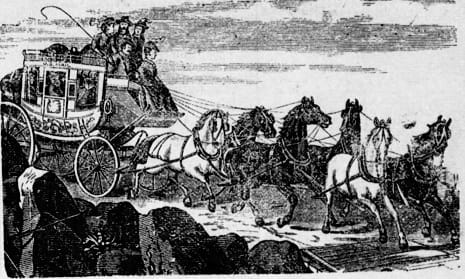
Concord stagecoach with six horses. (photo from the Tombstone Daily Epitaph)

The stagecoach driver usually had either four or six horses in front of him, and Kingsbury wrote that men capable of handling six horses and staying on schedule were much admired. Drivers were also repairmen; they provided first aid to horses and when necessary passengers; perhaps most important, they carried the latest news from stop to stop.

At first the Augusta-Bangor line used old-fashioned thoroughbrace coaches, with the body suspended on leather straps or thoroughbraces. Soon, Kingsbury wrote, the more comfortable Concord coach, invented in Concord, New Hampshire, became standard. Wikipedia explains that the Concord coach had a longer suspension system that better cushioned the ride and lessened stress on the coach body.

Wiggin described two stagecoach routes through the southern part of Albion, one without dates, one late in the 19th century. (As mentioned in the Albion history in the June 11 issue of The Town Line, Wiggin and Kingsbury both found confusing references to “South Albion,” which seemed to be two or three different places at different times.)

The undated stagecoach route was an Augusta to Bangor run that went through an especially deep muddy hollow. Depending on weather and road conditions, the stage driver would use four or six horses. When he had six, he could not easily reach the lead team with his whip. A local boy was kept on watch: when the coachman blew his horn as he approached the mudhole, the boy would run to the roadside and flick his whip to encourage the lead horses, while the driver handled the others.

The second stage route Wiggin described was actually either an express wagon or a buckboard route. (Wikipedia says the buckboard is an American invention, a cart designed for passengers as well as goods. Suspension is in the form of flexible floorboards plus a leaf spring underneath the seat.) It ran from Puddle Dock in southern Albion to Fairfield in the mid-1890s, with Martin Witham the driver.

Witham made two trips a day, six days a week, with one or two horses as conditions dictated. Wiggin’s history says his route went through Albion Corner, East Benton, Benton Falls (earlier in the 19th century the Falls had a hotel called the Reed House, Marriner wrote), Benton and Benton Station to Fairfield. Marriner added that even on this short route, Witham would change horses in bad weather.

The stage carried mail and passengers. Wiggin reported an (undated) letter from southern Albion residents to the U. S. Postmaster General asking him to restore the twice-daily runs, which had been reduced to once a day. She did not know whether the request was granted.

While Witham waited in Fairfield he would buy groceries and other items requested by people along the route. Marriner says this courtesy was common among stage drivers. Since they hadn’t time to stop to pick up a list, roadside residents would shout out their needs and the drivers would remember what to get and where to deliver it.

In the 1840s another stagecoach line operated briefly between Vassalboro and Newport, running through Benton, according to Kingsbury. Also, he wrote, from about 1841 until 1849 a one-horse cart functioned as a stage from Waterville through Benton and Unity to Bangor. After the railroad reached Waterville in 1849 (Kingsbury’s date), a larger coach drawn by four horses made the trip the rest of the way to Bangor, until the railroad was extended and supplanted it.

Farther north along the Kennebec, Kingsbury mentioned two stage routes that ran through Clinton. One, established about 1830, went from Waterville to Canaan. In its early years it crossed the Kennebec at Noble’s Ferry; later the route continued another two miles along the west shore to Pishon’s Ferry. In Canaan this route and the route from Skowhegan to Bangor met.

The second stagecoach through Clinton, Kingsbury wrote, was an Augusta to Bangor run that was started about 1850 and went through Waterville and Clinton. He listed three drivers’ names, but unfortunately provided no information about ownership or relationship to the earlier companies connecting the Kennebec Valley to Bangor.

Marriner’s history lists multiple stage lines running from Waterville. In his order, they were:

  • N. D. Pinkham’s Waterville and Bangor U. S. Mail, operating in 1855, which ran two stages a day in each direction by slightly different routes;
  • Morse and Mitchell’s Belfast stage that went through China and Freedom;
  • a run to Dexter and Dover that went up the Kennebec as far as Pishon’s Ferry and crossed there to Clinton;
  • D. D. Blunt’s twice-daily Skowhegan run, which extended to Moosehead Lake several days each week;
  • a daily run to Norridgewock; and
  • a twice-weekly run to The Forks.

In the history of Fairfield there is a passing reference to a stage stop at Nye’s Corner, which was a good-sized village until the 1840s. It had a church, stores and various small manufactories (making hats, coats, shoes, carriages, barrels and the like) and a hotel. The hotel included the post office and stables for stage horses, to rest and feed them on the trip from Waterville to Skowhegan. The writer added that the drivers, too, probably appreciated a chance for a break and perhaps a drink.

Stagecoaches from Augusta went not only upriver toward Waterville and on to Bangor, but east to Belfast and other parts of the coast and northwest toward Farmington.

South China, where there were several taverns along what is now Route 3 and at least one hotel in the village for much of the 19th century, was on the stage route from Augusta to Belfast.

Milton Dowe’s 1954 history of Palermo describes the stagecoaches that ran through that town, without giving dates or routes. They carried passengers and mail, Dowe wrote; the driver sat up high with baggage and mail behind him. From two to six horses were used, and because the stagecoaches were big and heavy, there were frequent stops at roadside taverns to change horses.

Millard Howard’s later (2015) history mentions stagecoaches between North Palermo and Montville. After the Sheepscot was bridged in 1826 about where Route 3 now runs, Arnold and Whittier opened an Augusta-to-Belfast route that carried mail and passengers.

Howard found its advertisement: the stage left Augusta at 8 a.m. Fridays and Sundays and “Eastman’s” at an unspecified time Wednesdays and reached Belfast the same day. Passengers coming west from Belfast “will have conveyance” from Palermo to China.

(Eastman’s was probably Thomas Eastman’s tavern and inn, which was probably near the east boundary of Palermo. The main road was at first called the Eastman Road. According to Howard and an on-line genealogy that almost certainly describes the same man, Eastman (1771-1840) was one of Palermo’s representatives to Maine’s 1820 constitutional convention, a legislator and an Associate Justice of the Waldo County Court of Sessions.)

The history of Windsor does not include transportation. Mentions of taverns and hotels in South Windsor and at Windsor Corner suggest stagecoaches might have run east from Augusta on what are now Route 17 in the southern part of town and Route 105 in the north.

An on-line document names five stagecoach lines that had stop-overs in Augusta in 1826: the Augusta and Bangor, Augusta and Belfast, Maine Stage’s Augusta and Waterville line, Maine Stage’s Portland and Augusta line and the Portland, Hallowell and Augusta line.

Alice Hammond wrote in the history of Sidney that by 1827, a Maine almanac listed five designated stagecoach routes in the state, including one linking Augusta with Anson that went through Sidney and Fairfield.

Kingsbury added another stagecoach line between Augusta and Farmington that went through West Sidney and made the settlement there the largest commercial center in town up to 1892, when his Kennebec County history was published. The village had several stores and taverns, two blacksmiths and a cooper, he wrote, and farmers shopped there not only from the west side of Sidney but from adjoining parts of Augusta, Belgrade and Readfield.

Main sources

Dowe, Milton E. History Town of Palermo Incorporated 1884 (1954)
Grow, Mary M. China Maine Bicentennial History including 1984 revisions (1984)
Hammond, Alice History of Sidney Maine 1792-1992 (1992)
Howard, Millard An Introduction to the Early History of Palermo, Maine (second edition, December 2015)
Kingsbury, Henry D., ed. Illustrated History of Kennebec County Maine 1625-1892 (1892)
Marriner, Ernest Kennebec Yesterdays (1954)
Robbins, Alma Pierce History of Vassalborough Maine 1771 1971 n.d. (1971)
Wiggin, Ruby Crosby Albion on the Narrow Gauge (1964)
Web sites, miscellaneous

Next: If you sought a (somewhat) smoother ride than the stagecoach provided, by the mid-19th century there were trains, and by the early 20th century trolleys and street railways.


Business breakfast to feature “Advocacy Refresher”

Tim Walton, founder, and president of Walton External Affairs will deliver a talk entitled “An Advocacy Refresher” as he explores why the Legislature matters to you and your business, as well as how a bill becomes a law.
This informative presentation will be the focus at Mid-Maine Chamber of Commerce’s September Business Breakfast. This month’s breakfast will be held on Thursday, September 10, from 7:15 to 9:00 a.m. in the Waterville Country Club Banquet Room at 39 Country Club Road in Oakland.

Walton External Affairs is an Augusta, Maine-based firm with an excellent reputation for strategic focus in the areas of government, business, and industry relations.

With a notable career spanning over twenty-five years, Tim has earned the reputation of being an effective, resourceful, and responsive voice for those he represents. He is well-known and highly respected for his commitment to customer service and client satisfaction.

Mid-Maine Chamber of Commerce holds monthly informative presentations on a variety of educational business topics. Cost of the Business Breakfast is $20 for members, $27 at the door and for non-members. Breakfast is included with the reservation.

To register, e-mail Cindy@midmainechamber.com or call 207-873-3315.

Local scouts rally in attempt to save Camp Bomazeen

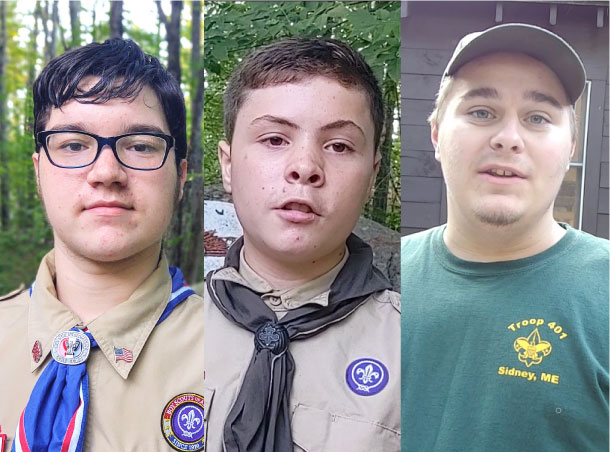
(left to right) Dalton Curtis, Zachary LeHay and Connor Keimel

Submitted by Chuck Mahalaris

Scouts from across the area are busy working on a new and difficult project. If they are successful, there is no merit badge for them to receive but something even better. They hope to save their beloved Scout Camp – Camp Bomazeen.

Dalton Curtis, of Skowhegan, Dawson White, of Sidney, and Zachary LeHay, of Oakland, are some of the Scouts who have begun circulating a petition to save Camp Bomazeen. The Scouts visited leaders during the recent Kennebec Valley District Scouter Recognition Dinner/ Program Kick Off at Camp Bomazeen. They asked them to sign the petition that night and to ask if any Scouts in their Pack and Troop want to help collect more signatures in their area. The petitions will be presented to the Pine Tree Council Executive Board at an upcoming meeting. In July, the council executive board voted to sell the camp this year – its 75th anniversary since opening.

Life Scout Connor Keimel, of Troop #401, Sidney, is one of the Scouts taking part in the petition drive and said, “Bomazeen has been a camp that I have gone to for so many years. I have made so many memories here. It would be such a shame if other Scouts coming forward didn’t have the opportunity to go there.” Eagle Scout Dalton Curtis, of Troop #485, in Skowhegan, said he learned to swim at Bomazeen and he loves all of the aquatics activities. Zachary LeHay, a Second Class Scout, from Oakland, said that he enjoys the camp in all the seasons. He has taken part in winter camping trips there and week-long summer camp experiences. Star Scout Dawson White, of Troop #401, in Sidney, loves the shooting sports program at Camp Bomazeen. “I have never been to another Scout camp. I just love it and would hate to lose it.”

Dalton’s mother, Tammy James, said that he has been working hard on collecting signatures but it has been hard with Covid-19. “Some people aren’t really happy about us going to their doors even with masks on,” she said. “But he is continuing to work on his sheet and will be bringing it to the troop leaders’ meeting. He really has gotten so much from his time at Camp Bomazeen. He would live there if he could.”

Former Camp Bomazeen Director Bruce Rueger, of Waterville, praised the Scouts for their effort. “I was heartened to see the Scouts doing this,” Rueger said. “They clearly have formed a strong bond with the camp. I think that is what happens. You spend so much of your time camping at Bomazeen, taking part in camporees there, working on merit badges there, learning about nature, exploring the world around you and discovering things about yourself as you do – it becomes a part of who you are and you want to preserve it for others. Camp Bomazeen has given to them and generations that have come before them and now they want to give back when Bomazeen needs their help the most. Bomazeen has made a remarkable difference in so many people’s lives since it was given to Scouting by Dr. Averill in 1944. Some of our Scouts went on to serve in the military, help the needy and run large corporations. Peter Vigue, CEO of Cianbro, in Pittsfield, was a Bomazeen Scout in 1959 as was his son and grandson as well. ”

Chris Bernier, of Winslow, runs the Bushcraft Program at Bomazeen which is a living history program designed to teach Scouts skills such as Native lore, blacksmithing, outdoor cooking, muzzle-loading, basket-making, metal working, woodworking, candle making, to hide tanning. The program transports Scouts from today back to the pioneer days of the 1840s. Before joining the staff, Bernier was a Scout at Camp Bomazeen. “I think that the Scouts wish to do this it is a great way for them to practice citizenship,” Bernier said. “They see something wrong and they are peacefully trying to make it better. They wish to see an active change and to do so in this manner is practicing what they learned in their citizenship badges. In this case Citizenship in the Community – the community of Scouting for them and future Scouts.”

Scouts from several communities including Jackman, Skowhegan, Sidney, Oakland, and Augusta are working the petitions that they began circulating on August 12. They hope to convince the Scouting Executive Board to reconsider their vote to sell the camp and, if not, that they hope to convince whatever entity buys the property to allow the Scouts to continue to use it as they have for the past 75 years.

For those who would like to lend their name to the petition but would not like a Scout to visit due to Covid-19 concerns, email FriendsofBomazeen@gmail.com or send a message to the Facebook page Friends of Bomazeen. Be sure to include your name, town and what Bomazeen means to you.